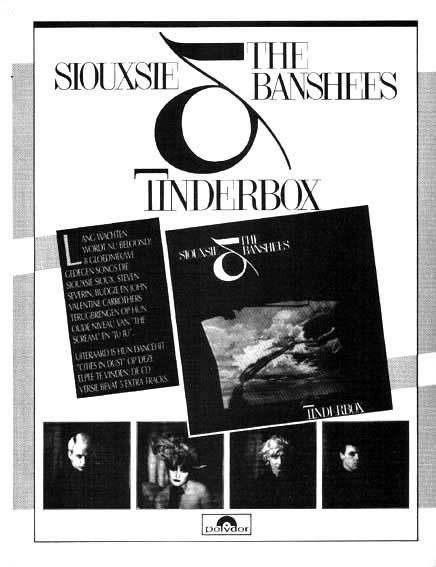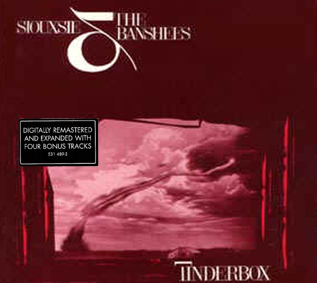
Cat: 531 489-3
Click on cover for full scan
Liner notes courtesy of Paul Morley
| TINDERBOX
Includes scans of LPs, cassettes, CDs, promos, imports, limited editions and adverts. Also includes track listings, catalogue numbers, release dates, chart positions, credits, liner notes and reviews. |
|
|
| REMASTERED ALBUM | |||
|
|
|||
| |
|||
| UK CD | Track Listing | ||
|
|
|||
| Cat: 531 489-3 Click on cover for full scan
|
|||
| Notes: |
All songs remastered Liner notes courtesy of Paul Morley |
||
| Released: | 06/04/09 | ||
| UK Chart: | No. | ||
| US Chart: | No. | ||
| Sleeve Design: | Photo: Lucille Handberg/Design: Billy Houlston | ||
| Re-issue Design: | Bold, London | ||
| Producer: | Banshees/Churchyard | ||
| Digitally Remastered By: | Kevin Metcalfe | ||
| Tapes Sourced By: | Steven Severin/Pete Matthews | ||
| LINER NOTES | ||
|
|
||
| And
then there was, hello darkness, a strange wind blowing, the world's
peaceful order giving way to a certain violence, nature committing
atrocities with haphazard fury, red of tooth and claw, heads and hearts
trampled by hooves, set the radar screens flickering holocaust, the
parties over but its only just begun, the leaves wither and no bud
appears, the sea beautiful under the moon, time itself is starting to
freeze over, the flash of a guillotine, certain divine rays break out of
the soul in adversity, freedom is priceless, the seventh studio album by
Siouxsie and the Banshees, in year of our lord 1986 A.D. It was an
apocalyptic thing and a half. (It's always a wonder that you can
talk about a group who had a series of Top 40 hits in such a way, as if
they were a pop group like, say, The Doors, T.Rex, The Monkees and
Kraftwerk, but one that consistently offered evidence of just how much
beauty the talented can wrest from fear. I am extremely happy that
there existed in the world a pop group of whom you can quite happily say
"they wrote songs that declared the world an activity of the
mind." As well as, you know, play loud, watch your back, it's
behind you, because they sounded as though they came from a country
where the capital city was called Cruelty, and they would spend the
nights savouring the sufferings of the obscurer mystics - Peter of
Alcantara, who managed to sleep no more than one hour a night, and
Margaret Ebner, who for days at a time "could not unclench hr
teeth; when she finally opened her mouth, it was to utter cries which
exalted and terrorised her convent." As well as, you know,
their rhythmical histrionics are as agitated and jerky as the movements
of a vampire.)
I'm not sure how you rank your Banshee albums - if you say put The Scream at number one, or Juju, or Kaleidoscope, or A Kiss In The Dreamhouse, or if you are feeling a little tense and needy, Hyaena, or even a little tender and broken hearted, Join Hands - but I sometimes think that Tinderbox is actually my favourite. Certainly it's often a second favourite to whatever is at the top, the album where the group's haunted blend of the punk, the pop, the glam, the psychedelia, the metal, the baroque, the nursery rhyme, the horror story, the tirade, the violence, the gentle, the jagged, the alien, the monsters, the velvet and steel, the ice and flame, the forked energy, the gritty surrealism, the grim, the perfectionism, the delicate, the labyrinths, the superstition, THE WARNING, was at it's most sensationally assured and damned serene. They were on a wavelength all of their own, and you can hear what and where they've been, as a group writing their own story, which consists of stories within stories about stories, from the very first seconds of the very first stinging, ringing, cursed and furious song, led by a voice full of other voices that is one of the most damned thrilling in rock. They then keep up their illuminating attack - this is who we are, and this is what we do - all the way through the album, never letting up, fighting all manner of natural and supernatural forces with a prodigious resilience that offer glimpses of what might be in a better world. To have such love for it is a bit perverse for me, as I'm of the generation that remains loyal to the Banshee guitarists/deputies that had all wandered into the desert by the time Tinderbox was made - my three favourite Banshee guitarists tend to be in the McGeoch, Smith, McKay area, and the Tinderbox guitarist was John Valentine Carruthers. He was, of course, brave not just because he was taking over that role in the group that had historically ended with various forms of sickness, disease, breakdowns and trauma. Brave also because the three guitarists best known in the role had left behind enough information about how the role should be played that it was difficult to know how the next in line could find room for their own thoughts. For all their flirtations with other sounds, found sounds, little bursts of ancient atmosphere and present tension, and even though the guitars often chimed and scattered like bells and strings, Siouxsie and the Banshees were a famously distinctive guitar group. What with one thing and another, perhaps because first of all they didn't really know what they were doing, or knew that they did not know what they were doing and turned that into a kind of advantage, they helped invent an electric guitar sound that somehow broke with rock conventions whilst radically reconfiguring some of the distressed fire breathing intensity of the wandering blues players. The history of guitar playing started again - renewed itself - around that seventies English punk period, and the way those punk people responded to, say, Richard Hell, Tom Verlaine and Lenny Kaye. It was guitar playing that plugged into the idea of austere, sombre, besieged blues from a space age, or even a literary, philosophical perspective. I guess drugs were involved too. The Banshees guitar sound surged, sliced and stunned, both urgently and calmly, in ways that were also connected to The Stooges, the Velvets, Can, Roxy, even Beefheart's Magic Band - where the blues had also been taken on a trip through time and into outer space - but other less sourced tones and temperatures were introduced, other resonances and spooky implications. Its how this guitar settled around, and inside, and over, and through the voice of Siouxsie that made it sound the way it did. The guitar sound was a reflection of, a response to, the way words and sounds, describing all manner of internal frustrations and anguish, charged across Siouxsie's lashing tongue and scattered into the outside world. Her voice and the guitar jousted and jostled with each other, and the flowering presence of Siouxsie's voice encouraged the guitar to find new positions, new hiding places, new ways to break into the open, to break down into silence, to crash into the shadows. The guitars sent Siouxsie higher and higher, and lower and lower. The guitar sounded the way it did because of the voice of Siouxsie, which required all sorts of discreet and less discreet accompanying movement to allow hr to bloom and swoop with the correct levels of articulate ferocity - as was happening elsewhere in Public Image and Joy Division because of the voices, the nervous disorders, the perilous decisions, of John Lydon and Ian Curtis. This guitar sound developed because singers inspired by punk to find new ways to express themselves needed the dynamics of the rock guitar as a support, but because what they were singing about was so unconnected to the assumed rock tradition, where love and sex and so on was the sentimental standard, this rock guitar had to find its own ways of breaking free of the obvious and the clichéd. This oblique, clipped but liberated guitar wasn't about sinewy lust or gaudy macho potency, snared in the present. It was more serious, and more mental, crossing itself out, fighting through time, and always less obvious. This mighty, melancholy, precisely imprecise guitar sound got handed from McKay to McGeoch to Smith, and each of them played this guitar sound - which McKay had plucked from the ground as if he was already aware of how the future players would deal with the idea of being a Banshees guitarist - in their own style, even as they accept the restrictive terms and conditions issued to them because they were a part of Siouxsie's carnal crew. And there was John Carruthers, coming from the north, the slithery Sheffield crash funk of Clock DVA, and he had all this guitar history, and Banshees' history, to contend with - the straightjacket, the legacy, the expectation, the ghostly guitarists breathing down his neck, the fact that these guitarists saw and heard things inside the group that meant that something was going to eat them up - and he ended up playing on one of the finest Siouxsie and the Banshees guitar records. And this was very much one that featured the classic combination of Severin's molten, salacious bass, Budgie beating time and time again with stirring focus, and the clash and closeness of the guitars - which a Led Zeppelin/Black Sabbath fan could enjoy as much as a Pop Group/Gang of Four fan - with Siouxsie's stern, lascivious voice in the wilderness and her WARNINGS about various things such as the weather and certain unresolved tensions and how to defend yourself from terror. Perhaps Carruthers decided to play as empathetically and aggressively as possible to ensure some kind of force field was erected around him that might repel whatever curse there was on the head of Banshee guitarists. Perhaps he very quickly accepted his role as something temporary and relished the nihilistic properties inherent in the job. It would, naturally, all come to nought, and there wasn't much future in it for Carruthers, and the endless desert stretched before him, but either in acceptance or defiance of that inevitability, he represented the restless host of Banshee guitarists, this ravishing collection of displaced comrades, all competing for space and attention, with absolute authority. You hear that invented sound, established and revised by McKay, McGeoch and Smith, and you hear new additions, corrections, confirmations. You hear a whole new ferocity that doesn't abandon the rules, nor shrivel up because of them. The Banshee guitarist lives again! And so he must die. You realise that very time Siouxsie and the Banshees found or nurtured or trapped a new guitarist, they became a fresh, ravenous new group, one that resembled the one before, but which shed its skin, and darted somewhere else. It's why here at album seven, ten years or so into their life, they slash across their own history, extending it and defying it, as if they are making another debut. This being a Siouxsie and the Banshees album, it is not too far fetched to consider that there is something in the notion that new guitar players were to the group new blood, and they needed an awful lot of this new blood to produce the kind of experience they were after, to maintain their youth, their looks and their emotional intensity. Tinderbox has rocked to a close. The door is shut. Sweet is the night air. There is a sudden calm. And a pause for breath. Paul Morley 18/12/08 Home |
||
| IMPORTS/PROMOS | |||
|
|
|||
| |
|||
| UK Promo CD | Track Listing | ||
|
|
|||
 Click on cover for full scan
|
|||
| Notes: |
All songs remastered Liner notes courtesy of Paul Morley |
||
| Released: | 06/04/09 | ||
| UK Chart: | No. | ||
| US Chart: | No. | ||
| Sleeve Design: | Photo: Lucille Handberg/Design: Billy Houlston | ||
| Re-issue Design: | Bold, London | ||
| Producer: | Banshees/Churchyard | ||
| Digitally Remastered By: | Kevin Metcalfe | ||
| Tapes Sourced By: | Steven Severin/Pete Matthews | ||
| PRESS | ||
|
|
||

|
||
More press... |
||
| LP/CD/CASSETTE | |||
|
|
|||
|
|
|||
| UK CD | Track Listing | ||
|
|
|||
| Cat: 829 145-2 Click on cover for full scan
|
|||
| Notes: |
*CD only
|
||
| UK LP | Track Listing | ||
|
|
|||
 Cat: SHELP 3 Click on cover for full scan |
|||
| UK Cassette | Track Listing | ||
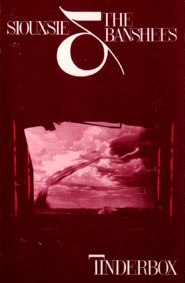
Cat: SHEMC 3 Click on cover for full scan |
|||
| Released: | 18/04/86 | ||
| UK Chart: | No. 13 | ||
| US Chart: | No. 88 | ||
| Sleeve Design: | Photo: Lucille Handberg/Design: Billy Houlston | ||
| Producer: | Banshees/Steve Churchyard | ||
| IMPORTS/PROMOS | |||||||||
|
|
|||||||||
|
|
|||||||||
| US Import Promo LP | Track Listing | ||||||||
|
|
|||||||||
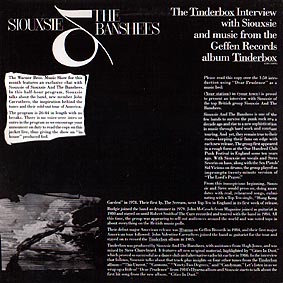 Click on cover for full scan
|
|
||||||||
| Japanese Import LP | Track Listing | ||||||||
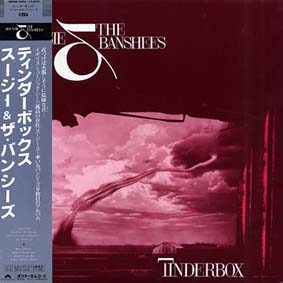 Cat: 28CM 0493
|
|||||||||
| Argentina Import LP | Track Listing | ||||||||
|
|
|||||||||
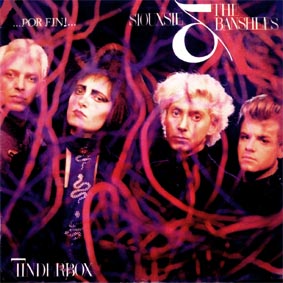 Cat: 829 145-1 Click on cover for full scan |
|||||||||
| PRESS | ||
|
|
||
|
|
||
| NME 19/04/86 | ||
|
|
||
|
|
||
|
|
||
| Quarterdrawing Of The Dog | ||
|
Instrumental |
||
| Quarterdrawing Of The Dog Credits | ||
| Sioux
- Piano & Whistle Severin - Bass Carruthers - Guitar Budgie - Drums & Waterphone |
||
|
|
||
| An Execution Lyrics | ||
|
This is what she saw |
||
| An Execution Credits | ||
Sioux
- Lyrics |
||
| Inspiration/Influence/Band Comment | ||
| Based on the 'myth' of Countess Bathory. "She (Siouxsie) was reading this book about Countess Bathory, called 'Was Dracula A Woman?' or something. She used to bath in the blood of virgins in the vain hope it would keep you young. (Carruthers) Source: Zigzag 12/85. | ||
|
|
||
| Lullaby Lyrics | ||
|
The lunacy will leave the day Wrap around this brilliant veil The dream swan spins Shaking down its morning swords O hush awhile I'll be watching over you |
||
| Lullaby Credits | ||
|
Severin -
Lyrics |
||
| Inspiration/Influence/Band Comment | ||
| King Ludwig II, the 'mad king' of Bavaria. Source: Downside Up liner notes. | ||
|
|
||
| Starcrossed Lovers Lyrics | ||
|
TBC |
||
| Starcrossed Lovers Credits | ||
| Severin
- Lyrics Sioux - Voice Severin - Bass Budgie - Drums & Percussion Carruthers - Guitar |
||